
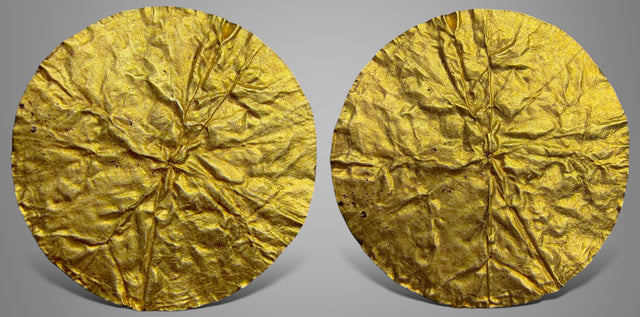

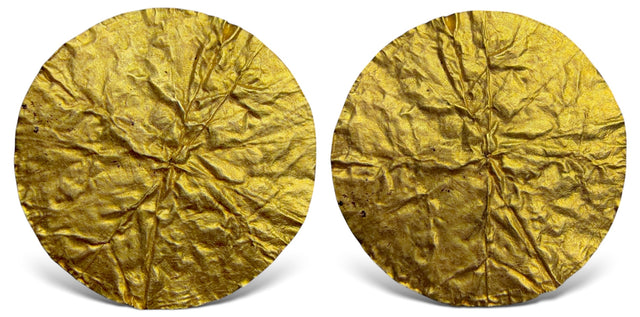

Central Asia, Hunnic Tribes, Silk Road Region, Local issue. Gold Bracteate, danake. Extremely fine and Rare type for thin gold discs.
£375.00
Inquire about this item ?
GA-1014
Central Asia. Hunnic Tribes, Silk Road Region, Local issue. Gold Bracteate danake.
0.41gm, 23mm, Found in Silk Road region in burial site.
Hard to tell as heavily creased with some black spots of patina / same as obverse with no patina.
Zeno-371554 (It's me there). Extremely fine and Rare type for thin gold discs.
An attractive type of cross-cultural interest.
Please see Cf. Göbl, Dokumente pl. 87, B1, cf. Stein (Wang) p. 239 = BM IA.XII.c.1; V. Raspopova, "Gold Coins and bracteates from Pendjikent," in Coins, Art, and Chronology, pp. 453-460; cf. A. Juliano and J. Lerner, eds. Monks and Merchants: Silk Road Treasures from Northwest China, pp. 271-291.
What do you mean by Danake?
An
AV Danake (gold danake) is a coin, or often a thin gold foil pseudo-coin, that was placed with the dead as a form of "Charon's obol". This practice was a Greek and Roman funerary tradition intended to pay Charon, the ferryman of Hades, for passage across the rivers Styx and Acheron to the underworld.
The Meaning of the Burial Coin
- Payment for Passage: The primary belief was that the soul needed to pay a toll (naulum or "boat fare") to Charon for his service. Without payment, the soul would be forced to wander the shores of the river for one hundred years, unable to find rest in the afterlife.
- A Necessary Ritual: Placing the coin ensured the deceased received proper burial rites and could complete their journey into the underworld, showing respect for their passage.
- Symbolic Value: The small denomination of the coin (an obol was one-sixth of a drachma) was sometimes seen as a reminder that death is an equalizer of all people, rich or poor.
- Grave Goods: Archaeologists often use "Charon's obol" as a shorthand term for any coinage found as grave goods in ancient burials, especially those of a small denomination, even if they were not placed in the mouth.
The Danake Itself
- The term danake (Greek: δανάκη, Old Persian: dânake) originally referred to a Persian silver coin, roughly equivalent to a Greek obol in value or weight.
- Over time, the Greeks used the term loosely for any small, foreign or demonetized coin used in this burial context.
- Sometimes, instead of a real coin, a very thin, flimsy gold foil "pseudo-coin" (also called a lamella) was created, specifically for the burial ritual, as it had no value as actual currency but fulfilled the mythological requirement.
The use of the AV danake, therefore, reflects the ancient belief in an afterlife journey requiring a specific payment, ensuring the soul's successful transition from the world of the living to the realm of the dead.