
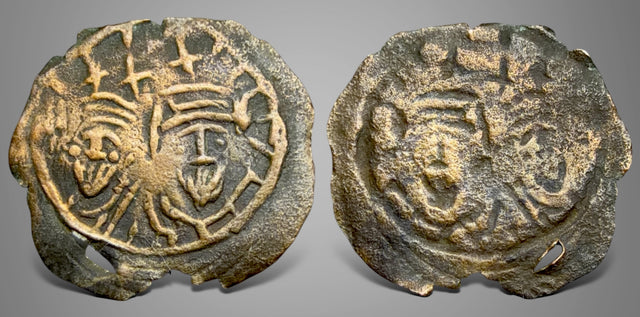

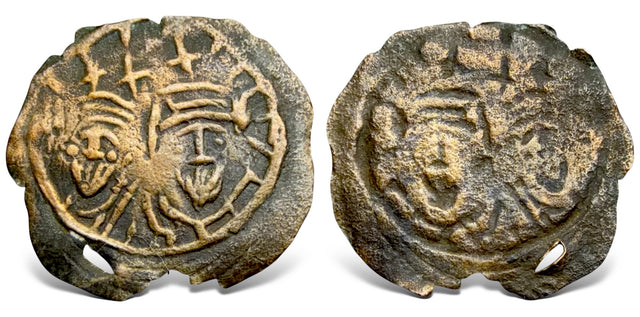

Central Asia, Hunnic Tribes, Silk Road Region, Local issue, Imitating Byzantines. AE Bracteate.
Sold Out
£175.00
Inquire about this item ?
GA-1183
Central Asia, Hunnic Tribes, Silk Road Region, Local issue, (Circa 5th-8th centuries), Imitating Byzantines. AE Bracteate.
0.43gm, 20.7mm, Local issued in Silk Road Region.
Imitating an AV Solidus of Heraclius and Heraclius Constantine.
Crowned facing busts of Heraclius and Heraclius Constantine; cross above / Incuse of obverse.
Normally buried with deceased person.
Zeno-383446 (It's me there). More similar items here. Good very fine. nice toning.
An attractive type of cross-cultural interest. Unique style.
Please see Cf. Göbl, Dokumente pl. 87, B1, cf. Stein (Wang) p. 239 = BM IA.XII.c.1. also V. Raspopova, “Gold Coins and bracteates from Pendjikent,” Coins, Art, and Chronology, pp. 453-60, for discussion of Silk Road bracteates, especially figs. 1-8 for other specimens copying Late Roman/Byzantine issues.
During the seventh century AD, the Byzantine solidus was the de facto trade currency of the Mediterranean world. The denomination saw wide circulation beyond the borders of the Empire, both in the Germanic western half of Europe and along the Silk Road. Solidi and their sundry bracteate imitations are regularly found in burials along the trade routes of Central Asia, even from as far afield as the metropolitan regions of northern China. Thierry and Morrison (Sur les monnaies byzantines trouvées en Chine, in RN 1994) record twenty-seven specimens ranging in date from Theodosius II to Constantine V recovered from Tang dynasty tombs. They note that neither official nor bracteate solidi survive in sufficient quantities to suggest a circulating currency. Rather, the gold coins functioned as prestige objects for wealthy merchants and nobles.